
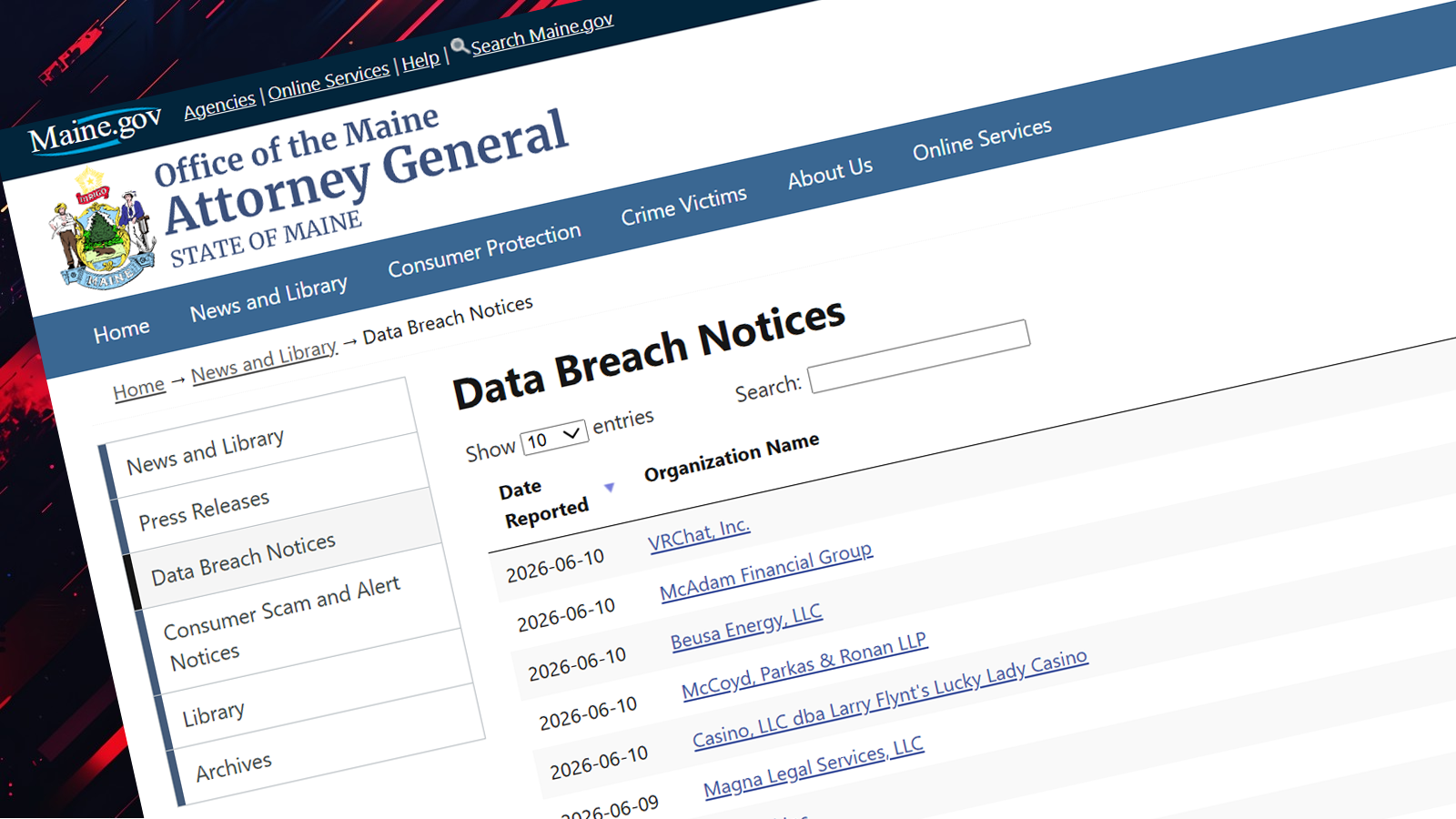
When a state attorney general’s breach portal lists your company, you assume someone actually broke in. That assumption just broke. This week, Maine’s official portal published fraudulent breach disclosures against companies that hadn’t been breached at all, and several of the named companies had to publicly deny the incidents before regulators pulled the entries. The attack didn’t touch a single firewall. It touched the public system that tells the world a firewall failed.
This is a different kind of cybersecurity story than the usual ransomware-of-the-week. The disclosure pipeline, the AI summaries, the regulator’s web form, the press wire that quotes them: all of these are attack surface now. And almost nobody owns defending them.
The Attack That Skipped The Network
BleepingComputer reported that unknown actors submitted fake breach disclosures to Maine’s portal, which publishes entries automatically before legitimacy is verified. Companies on the receiving end had to scramble to deny breaches that never happened. There’s no malware to analyze, no IOC to share, no lateral movement to hunt. The “attacker” filled out a web form.
The damage model is more interesting than it looks. A fraudulent breach notice can move a stock price, trigger a vendor questionnaire panic, generate compliance review costs, and feed every threat intelligence aggregator on the internet. Once an entry hits a regulator portal, it gets quoted, scraped, re-summarized by AI models, and lives forever in the long tail of “company X had a breach in 2026.” Good luck retracting that.
It doesn’t matter if no real intrusion occurred. The signal goes out anyway, and threat detection programs at downstream partners react as if it had.
Three Stories, One Broken Truth Channel
Three news items hit the wire this week that look unrelated, until you notice they all undermine the same thing: trust in the channels that report breaches and corporate facts.
Kyushu Electric, Maine, And Google In One Frame
Kyushu Electric Power lost private data on 10.9 million customers when a physical drive went missing. No zero-day. No malware. Someone walked off with a drive. The breach is real, the disclosure is real, and the lesson is that defense in depth still has to include the parts of the data lifecycle nobody puts in a SOC report.
The Maine portal incident is the inverse: fake breach, real disclosure. The truth channel got weaponized while the company’s network sat untouched.
Then there’s the German court ruling that Google can be held liable for false statements in its AI Overviews. “AI can make mistakes” is no longer a sufficient defense. A platform that generates assertions about real companies and people owns those assertions legally. Read alongside the Maine story, the implication is uncomfortable. If an AI Overview repeats a fraudulent breach disclosure, the publisher is exposed too.
Three different incidents, one common thread. The infrastructure that says “this happened” is brittle, partially automated, and increasingly trusted by people who don’t have time to verify.
Cybersecurity Teams Don’t Own The Disclosure Channel
Inside most security organizations, nobody owns this. The CISO owns the network. Legal owns the regulator relationship. PR owns the press. The SOC owns alerts. The cyber security playbook for “we got named in a fake breach disclosure” generally does not exist, because the threat model assumed breach notices were inputs from trusted sources, not adversary-controlled traffic.
That assumption was reasonable in 2015. It isn’t reasonable now. Anything publicly indexed, automatically published, or aggregated by AI is a place an adversary can plant a story about you. The brute-force route into your customer trust isn’t through your firewall anymore. It’s a form submission at a state agency portal, an unmoderated breach tracker, or a generative summary that hallucinates an incident.
Security hardening for technical assets is mature. Security hardening for the information channels that describe your company is barely a category.
Defending Yourself Before You Get “Breached”
The good news: most of the response work here is operational, not technical, and your existing teams can absorb it. The bad news: somebody has to actually do it.
- Monitor every state breach portal and aggregator that names companies. Set up alerts on your company name, subsidiaries, and major product brands in the Maine portal, California AG portal, HHS OCR breach reports, and the major breach trackers. If a fraudulent entry appears, you want to know within minutes, not when a customer emails you.
- Pre-stage your denial. Draft a takedown request, a public statement, and a regulator contact list before you need them. The companies caught flat-footed in Maine spent hours assembling responses that should already have been on the shelf.
- Audit your AI mentions. Query Google AI Overviews, ChatGPT, Perplexity, and Gemini for assertions about your company quarterly. Document them. The German ruling gives you legal standing to demand corrections. Use it.
- Build incident response for reputational events. Run a tabletop where the trigger is a fraudulent breach disclosure, not a SIEM alert. Who calls the regulator? Who drafts the statement? Who briefs the sales team before customers ask? Most playbooks have none of this.
- Cover the physical layer too. Kyushu Electric proves the boring controls still matter. Encrypted disks, chain-of-custody logs for portable media, brute-force controls on adjacent auth surfaces (tools like IPBan Pro fit here) in case the drive is decrypted later, and a real inventory of where customer data physically lives.
- Treat threat-protection as multi-channel. Network detection is solved-ish. Brand and disclosure-channel detection isn’t. Fund both.
None of this is glamorous. None of it requires a new product category. It requires deciding that the channel that tells the world about your security posture is in scope for your security program.
The Legal Layer Just Showed Up
The German AI Overviews ruling matters even if you don’t operate in Germany. It signals that courts have stopped accepting “the model said it” as a liability shield. Platforms that publish AI-generated assertions about your company can be compelled to correct them. That cuts both ways: useful when an AI hallucinates a breach you didn’t have, dangerous if your own AI products misstate facts about customers or competitors.
Pair the ruling with the Maine portal abuse, and the legal department needs a security-aware process for forcing corrections in regulator databases, AI summaries, and breach aggregators. The press isn’t going to do it for you. Neither is the regulator that published the fake notice in the first place.
Frequently Asked Questions
- Can someone actually file a fake breach disclosure against my company?
- In several state portals, yes. Maine’s system published fraudulent submissions before validation. Assume any portal that accepts public submissions can be abused, and monitor accordingly.
- Does the German AI Overviews ruling apply to US companies?
- Not directly, but it creates a precedent other jurisdictions are likely to follow. More importantly, it gives you a recognized legal argument when demanding corrections from platforms that publish AI-generated falsehoods about your business.
- Is encrypting backup drives enough to handle Kyushu-style physical losses?
- Encryption helps but it isn’t the whole answer. You also need chain-of-custody logging, an inventory of every device holding sensitive data, and brute-force controls on any auth path that could later decrypt the data if a drive is recovered by an adversary.
Sources
- Maine breach portal abused to publish fake data breach disclosures
- Japanese energy firm loses drive with data of 10.9 million clients
- Google can be liable for false AI Overviews, court rules
Take Control of Your Server Security
Don't let brute-force attacks slow you down. Try IPBan Pro risk-free for 30 days.
Secure. Automated. Lightweight.

Take Control of Your Server Security
Don't let brute-force attacks slow you down. Try IPBan Pro risk-free for 30 days.
Secure. Automated. Lightweight.