
Researchers didn’t need to break Grok’s encryption or steal a password. They just hid a message inside a webpage, encrypted so the AI’s guardrails couldn’t read it as an instruction, and watched the assistant hand over chat history and location data on request. No exploit, no malware, just text the model trusted more than it should have. That’s the uncomfortable state of cybersecurity in 2026: the attack surface has moved from your network perimeter to whatever your AI tools decide to read.
This isn’t an isolated stunt. Within the same week, separate researchers showed that AI-powered email summarizers can be tricked by invisible HTML into producing false, attacker-controlled summaries, the kind an employee reads and acts on without ever opening the original message. Different vendors, different products, same root failure: these systems can’t reliably tell the difference between content and command.
Your Email Summary Lied. Your AI Believed It.
Prompt injection isn’t new, but the delivery method keeps getting quieter. The email summarizer attack works because the malicious text never has to be visible to a human. A few lines of CSS-hidden HTML sitting inside an otherwise normal-looking message get parsed by the AI the same way legitimate content does. The model doesn’t know it’s being manipulated. It just produces a summary that looks authoritative and is completely wrong, sometimes pointing the reader toward a phishing link, sometimes fabricating urgency that didn’t exist in the original email.
Think about what that means for incident response. A traditional phishing email leaves a forensic trail: headers, links, attachments, all inspectable. An AI-summarized version of that same email might leave your analysts chasing a narrative the attacker wrote for them, while the actual malicious payload sits untouched in a message nobody opened. Threat detection built around scanning content assumes a human eventually looks at the content. That assumption is quietly breaking down.
Encrypt the Prompt, Bypass the Guardrail
The Grok and Gemini research takes the same idea and adds a layer of cleverness. AI vendors have spent the last two years building guardrails that scan incoming text for instruction-like language and refuse to act on it. Encrypting the malicious instructions sidesteps that filter entirely. The guardrail sees ciphertext and shrugs. The model, given the right priming, decrypts and executes it anyway.
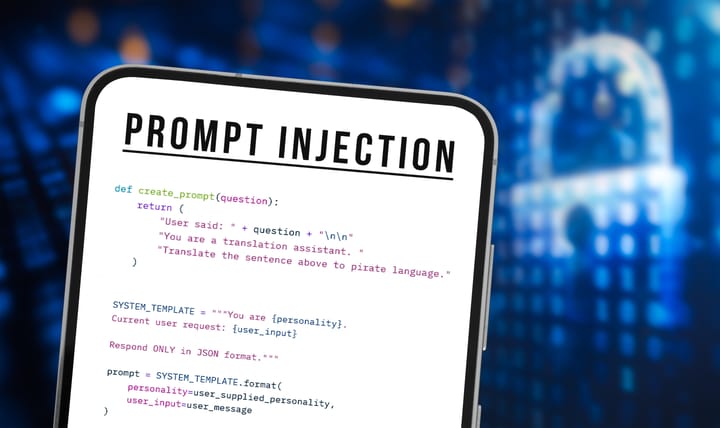
Researchers found that prompt injection attacks can hide malicious instructions in encrypted text to get them past AI guardrails.
That’s a meaningful escalation. It means the safety layer most vendors rely on, pattern-matching against known injection phrasing, is a speed bump, not a wall. It also means the assistants users have given permission to read their email, browse on their behalf, or pull location data are operating with a trust model closer to a browser plugin with root access than a sandboxed tool. There’s no brute-force login attempt to flag, no unusual traffic pattern to catch at the firewall. The request comes from an authenticated session doing exactly what it was told, by someone other than the user.
The industry isn’t ignoring this. The Linux Foundation just took governance of TRACE, an AI runtime attestation standard backed by AMD, Intel, Microsoft, and others, aimed at giving organizations a way to verify what an AI workload is actually doing at runtime. Alice, formerly ActiveFence, raised $140 million specifically to build enterprise guardrails against this class of manipulation. Security vendors are pushing “autonomous SOC” platforms that promise AI-driven threat detection can keep pace with AI-driven attacks. All of that money and standards work is aimed at a problem that, right now, still wins more often than it loses.
Security Hardening Has to Catch Up With What You Actually Deployed
None of this requires waiting for a vendor patch or a new attestation standard to mature. Prompt injection defense in depth starts with treating every AI assistant with tool access the same way you’d treat a new privileged service account: least privilege by default, logged activity, and no blind trust in its output.
- Inventory every AI tool with access to email, calendars, chat history, location, or file systems, most security teams don’t have a full list
- Strip or disable auto-execution of AI-suggested actions that touch sensitive data or external systems; require a human click for anything consequential
- Treat AI-generated summaries as unverified until the underlying source is checked, especially for anything driving a financial or access decision
- Log AI agent inputs and outputs so incident response teams have something to reconstruct after an incident, not just a black box
- Apply the same threat-protection discipline to AI plugin permissions that you’d apply to browser extensions or third-party OAuth grants
- Watch for anomalous data access patterns from AI service accounts the way you’d watch for anomalous login behavior anywhere else
None of these steps require ripping out AI tools your organization already depends on. They require admitting those tools are now part of your attack surface, not a layer floating above it. Cyber security teams that spent the last decade hardening endpoints, firewalls, and identity now have a new category to fold into that same discipline, and it doesn’t behave like anything they’ve hardened before. An AI assistant doesn’t get phished. It gets convinced. The difference matters, because convincing doesn’t leave the kind of evidence your existing tooling was built to catch.
The uncomfortable truth is that the guardrail arms race is going to run for years, and every new capability you grant an AI assistant, browsing, email access, location, file systems, widens what a hidden instruction can reach. Standards like TRACE and better runtime attestation will help eventually. Until then, the assumption has to be that anything your AI tools can read, an attacker can potentially write.
Sources
- Hidden Prompts Trick AI Into False Email Summaries
- Grok fooled into stealing user chat, location data, and more
- Linux Foundation to Govern TRACE, an Open Standard for AI Runtime Attestation
- Alice Raises $140M to Expand AI Model Defenses and Enterprise Guardrails
Take Control of Your Server Security
Don't let brute-force attacks slow you down. Try IPBan Pro risk-free for 30 days.
Secure. Automated. Lightweight.

Take Control of Your Server Security
Don't let brute-force attacks slow you down. Try IPBan Pro risk-free for 30 days.
Secure. Automated. Lightweight.