
Researchers at Paradigm Shift just published a working exploit, usbliter8, that runs arbitrary code inside the SecureROM of Apple’s A12 and A13 chips. That code is etched into the silicon at the factory. No iOS update reaches it, no configuration profile disables it, and every affected device carries the flaw until it’s retired. For anyone whose cybersecurity program leans on “we’ll patch it next cycle,” this is a useful slap in the face. Some flaws don’t have a next cycle.
It pairs nicely with a quieter story from the same week: a phishing email aimed at a major Belgian bank that hid its destination inside an IPv4-mapped IPv6 address. One flaw can’t be patched. The other can’t be cleanly blocked. Together they expose the two verbs defenders reach for by reflex, patch and block, and the hard floor under both.

A boot-chain flaw written into the chip, with no update path
SecureROM is the first code an Apple device runs at power-on. It’s the root of the chain that decides whether the rest of the boot process can be trusted. Getting arbitrary execution there means an attacker sits below the operating system, below the security framework, below every detection agent you might deploy. The A12 and A13 cover a wide swath of iPhones and iPads still in daily corporate use.
The saving grace, and it’s a real one, is that usbliter8 needs physical access over USB. This is a local attack, not something that arrives in an email. So the threat model is narrow but nasty: a lost or stolen device, a phone seized at a border, a tablet left in a hotel room, a piece of hardware that passes through a repair shop or a resale channel. In those scenarios, the device-level passcode and disk encryption are doing more work than any patch ever could.
Plan for these devices the way you’d plan for any asset that will never be fully fixed. Know which models you own, know who carries them, and shorten their lifespan in roles that handle sensitive data. The flaw outlives the firmware, so your defense has to outlive the assumption that an update is on the way.
The same phishing link, written so your filters can’t read it
The Belgian bank phish took a different route to the same lesson. Instead of a normal domain or a plain IPv4 address, the malicious link used an IPv4-mapped IPv6 address, a format that wraps an IPv4 address inside IPv6 notation. The destination is identical. The text representation is not. A blocklist that knows the dotted-decimal form may sail right past the mapped form, and a hurried analyst reading the raw header sees a string that doesn’t trip the usual alarm bells.
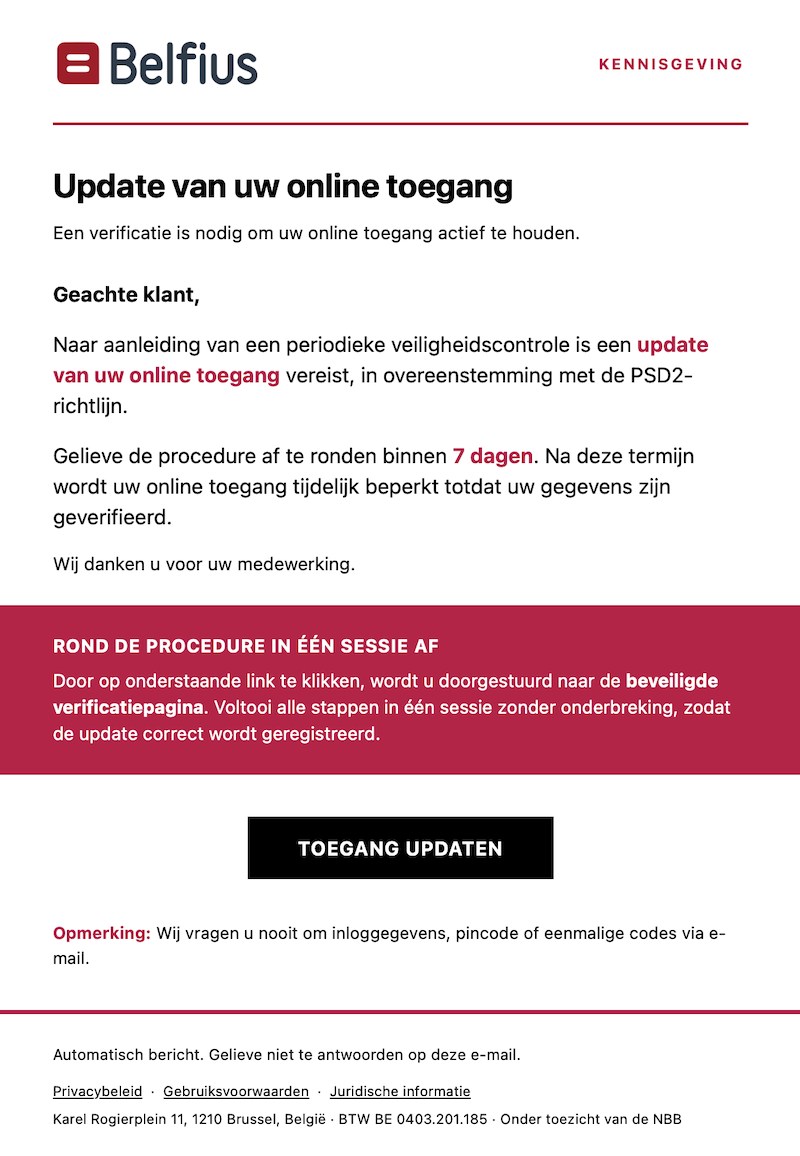
This is an old trick in new clothes. Attackers have abused hex-encoded IPs, octal notation, and URL-encoded characters for years, and the goal is always the same: write the bad destination in a form your tooling didn’t normalize. The lesson for threat detection is blunt. If your matching logic compares strings instead of resolving and canonicalizing the actual target, you’re matching the disguise instead of the attacker.
Why patch-and-block thinking has a hard floor in cybersecurity
Both stories puncture the same comfortable assumption. We tell ourselves that a vulnerability gets patched and a malicious indicator gets blocked, and then the risk is handled. usbliter8 has no patch. The IPv6-mapped phish has no clean block, because the next campaign will just pick a different encoding. Treating either as a checkbox is how you end up exposed.
The way through is the same principle that’s quietly carried defenders for decades: defense in depth. You assume any single control will fail and you arrange the others to catch what slips. The firewall and the URL blocklist are one layer, not the whole wall. When that layer misses a mapped address, a second layer should be watching what the user does after the click, and a third should be limiting what a stolen session or a compromised device can reach.
That mindset also reframes incident response. If a control can’t be relied on to stop the threat, you need to be ready for the moment it doesn’t. A lost A12 phone, a credential harvested through a phish your gateway waved through, a brute-force run against a login that your edge device never escalated. None of those should be a surprise, and none should require improvisation at 2 a.m.
Operational controls for flaws you can’t patch and links you can’t trust
Here’s where to spend effort when the patch and the blocklist run out of road. Immediate moves first, then the ongoing work.
- Inventory your unpatchable assets. Identify A12/A13 devices and any hardware with no update path, and flag them for shorter refresh cycles and tighter handling rules.
- Enforce strong device passcodes and full-disk encryption. Against a physical-access attack like usbliter8, the passcode is your real control, so kill four-digit PINs and require remote wipe on lost-device reports.
- Canonicalize before you match. Make sure your mail gateway, proxy, and threat detection rules resolve and normalize addresses, IPv4-mapped IPv6 included, instead of comparing raw strings.
- Put brute-force controls on every authentication endpoint. Rate-limit, lock out, and escalate at the edge so a credential leaked through a phish can’t be quietly hammered into access.
- Cap session lifetime and bind tokens. Shorten how long a stolen session stays useful, because phishing-resistant MFA still leaves token theft on the table.
- Rehearse the failure case. Run a tabletop where the control missed: a seized phone, a phish that landed, a login your firewall let through. Practice the response before you need it.
Security hardening isn’t about pretending flaws won’t exist. It’s about building an environment where one unpatchable chip or one cleverly encoded link doesn’t cascade into a breach. The teams that weather 2026 well will be the ones who stopped treating “patch it” and “block it” as the end of the conversation and started designing for the moment those words don’t apply.
Sources
- Unpatchable ‘usbliter8’ Exploit Breaks Apple A12 and A13 SecureROM Boot Chain
- eBanking Phishing Delivered Through IPv4-Mapped IPv6 Address
Take Control of Your Server Security
Don't let brute-force attacks slow you down. Try IPBan Pro risk-free for 30 days.
Secure. Automated. Lightweight.

Take Control of Your Server Security
Don't let brute-force attacks slow you down. Try IPBan Pro risk-free for 30 days.
Secure. Automated. Lightweight.