
Every organization running Linux workloads in the cloud right now has a quiet assumption baked into their security posture: that privilege separation is holding. CVE-2026-31431, nicknamed “Copy Fail,” just punched a hole in that assumption. With a working exploit already circulating in the wild, the gap between “we run Linux containers” and “we have confirmed root isolation” is wider than most teams want to admit. This is a cybersecurity incident waiting to happen if your detection and hardening efforts haven’t caught up with the disclosure yet.

What makes this one hurt more than a typical kernel CVE is the blast radius. This isn’t a corner-case flaw that only fires under lab conditions. Cloud environments and Kubernetes workloads are the explicit targets, which means the attack surface is nearly every production Linux deployment at scale. The organizations most exposed aren’t running legacy hardware in a basement; they’re running modern container infrastructure that security teams generally trust as hardened by default. That trust is the problem.
Copy Fail Is Not a Niche Kernel Bug
The name sounds almost polite, but the impact is not. CVE-2026-31431 exploits a flaw in how the Linux kernel handles certain memory copy operations, allowing an unprivileged local user or a compromised container process to escalate to root. In a standalone server environment, that’s bad enough. In a multi-tenant Kubernetes cluster, it’s potentially catastrophic because the blast radius extends across workload boundaries.
Microsoft’s threat intelligence team flagged that the exploit is already functional, which compresses your remediation window dramatically. The usual luxury of “we’ll patch this in the next scheduled cycle” doesn’t apply here. When working exploit code exists outside a lab, you’re racing attackers who have already built automation around it.
Where the Real Risk Sits in Kubernetes
Container environments introduce a specific wrinkle that bare-metal thinking misses. Many organizations run pods with more capability than they actually need, relying on namespace isolation as a compensating control. Copy Fail can exploit that overconfidence. If a containerized process can trigger the vulnerable code path, and the node’s kernel is unpatched, the escalation path to the host OS is real. From there, lateral movement to adjacent workloads, credential stores, and cloud metadata endpoints becomes significantly easier.
The clusters most at risk are the ones where least-privilege hasn’t been enforced at the pod security level, where runtime security tooling is absent or tuned passively, and where kernel versions lag behind because upgrades require downtime no one wants to schedule.
The cPanel Bug Deserves the Same Urgency
Separately, a critical authentication bypass in cPanel and WHM is under active exploitation, and the exposed population is enormous. Hosting providers, managed service providers, and independent site operators who rely on cPanel’s administrative interface are all potentially exposed. An attacker can access the interface without any valid credentials, which means your first line of defense is entirely bypassed before the threat detection stack even sees a suspicious login.
The connection to Copy Fail is worth drawing explicitly. Both vulnerabilities represent the same class of failure: they let attackers operate as though authentication and privilege restrictions don’t exist. In cPanel’s case, the authentication check fails. In Copy Fail’s case, privilege separation fails. The outcome in both is that the attacker ends up with rights they were never supposed to have, and your environment doesn’t know anything went wrong until the damage is done.
If you’re running cPanel/WHM on any customer-facing or internal infrastructure and haven’t applied the patch, that’s a five-alarm situation. Millions of websites sit behind this software, and the exploit is confirmed active, not theoretical.
Legitimate Infrastructure as an Attack Platform
The Google AppSheet phishing campaign targeting Facebook accounts is a different category of threat, but it belongs in the same week’s conversation because it illustrates how far attackers have moved beyond obvious indicators of compromise. A Vietnamese-linked operation used AppSheet, a legitimate Google low-code platform, as a phishing relay, embedding malicious links in emails that appear to originate from trusted Google infrastructure. Roughly 30,000 Facebook accounts were compromised and funneled into an illicit storefront run by the threat actors themselves.
This approach is becoming standard. Threat actors pick platforms that email security gateways and web filtering tools are reluctant to block outright because they serve legitimate business purposes. Your firewall rules and your email filtering allow Google AppSheet traffic. That’s exactly why it works. The accountDumpling campaign, as Guardio named it, is a reminder that perimeter-layer threat protection needs behavioral and contextual signals, not just domain reputation scores.
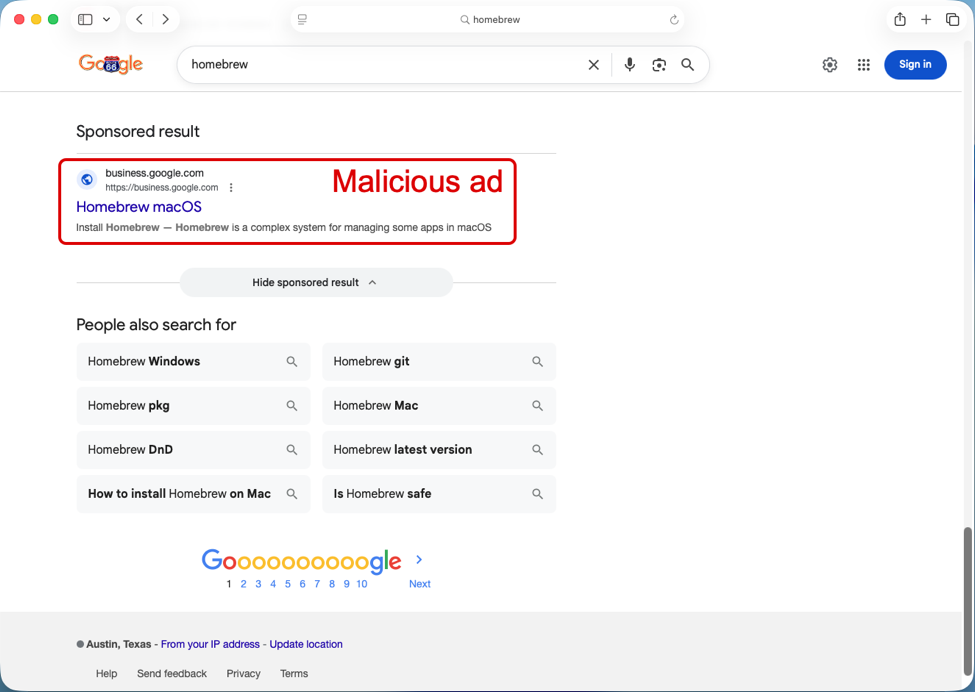
The MacSync Stealer campaign operating through fake Homebrew ads tells a nearly identical story on macOS. Users searching for a tool they use every day clicked an ad that looked correct and ended up with a credential-stealing payload. The delivery mechanism was the ad network, not a dark web forum. Legitimate infrastructure, trusted surface, hidden payload.
Practical Steps to Reduce Your Exposure Right Now
These three threats require different technical responses, but they share a common mitigation philosophy: don’t wait for your next change window.
For CVE-2026-31431, the priority order looks like this:
- Identify your kernel versions across all Linux hosts and nodes, including managed Kubernetes node pools. Your cloud provider may have already applied patches to managed control planes, but worker nodes often require manual action or a node pool rotation.
- Apply vendor patches immediately. For environments where kernel upgrades require downtime, schedule an emergency window and document the risk acceptance period explicitly.
- Audit pod security configurations in Kubernetes. Enforce restricted pod security standards, drop unnecessary capabilities, and ensure no container runs with
hostPID,hostNetwork, orprivilegedflags unless absolutely required. - Enable runtime security monitoring at the kernel level. Tools like Falco or similar eBPF-based agents can detect privilege escalation attempts in real time, even before a patch is deployed. Detection isn’t remediation, but it shortens your incident response window considerably.
- Review your cloud metadata endpoint access controls. A successful escalation that reaches the host OS can access instance metadata, which often contains credentials and IAM role tokens. Restrict IMDS access to only the processes that genuinely need it.
For the cPanel bypass, the answer is binary: patch or take the interface offline until you can. There is no compensating control that fully substitutes for fixing an authentication bypass in administrative software. If you need a stopgap, restrict access to the WHM port using firewall rules that allow only known management IP ranges, and monitor all successful and failed authentication events closely.
For phishing campaigns abusing legitimate infrastructure, the defense has to move upstream. User awareness training remains relevant, but it can’t carry the full weight. Configure DMARC, DKIM, and SPF strictly on your own domains, and push your email security tooling to evaluate link destinations and sender behavior patterns rather than relying primarily on domain reputation alone. Sandboxing links at click time, not just at delivery, closes a significant portion of the gap.
The Incident Response Question Nobody Asks Fast Enough
When Copy Fail or the cPanel bypass gets used against your environment, the first question your incident response team will face isn’t “how did this happen.” It’s “how long has the attacker been in here.” Privilege escalation attacks are particularly dangerous because the initial exploitation can be quiet. The attacker gains root or admin access and then sits, enumerates, and plans. The noisy phase comes later.
That delay is exactly why your detection coverage needs to include post-exploitation behavior signals, not just entry-point indicators. Look for processes spawning unexpected child processes with elevated privileges, unexpected outbound connections from kernel-level or cPanel system contexts, new user accounts or SSH key additions, and access to credential stores or environment variable files that shouldn’t be read under normal operation.
Security hardening before an incident is the only way to shorten the attacker’s dwell time. Immutable infrastructure helps here too. If your Linux nodes rebuild from a known-good image on a regular cadence, the window for a persistent implant to survive is dramatically reduced.
Frequently Asked Questions
- Does CVE-2026-31431 affect managed Kubernetes services like GKE, EKS, and AKS?
- It depends on the component and node version. Managed control planes are typically patched by cloud providers quickly, but worker nodes, especially if you manage your own node groups, may require manual patching or rotation. Check your cloud provider’s security bulletins and don’t assume a managed service means fully protected. Node pool upgrades are your responsibility in most configurations.
- The cPanel bypass is serious, but my hosting provider manages cPanel for me. Am I still at risk?
- Yes. Your provider’s patch status is what matters, and you often can’t verify that directly. Contact your provider for confirmation of patch application, and ask for evidence. If you’re running a VPS or dedicated server where you manage cPanel independently, apply the patch yourself immediately. Don’t assume someone else handled it.
- How do you defend against phishing campaigns that abuse legitimate platforms like Google AppSheet?
- Domain reputation filtering alone won’t catch it. You need behavioral analysis that evaluates what a link does when followed, not just where it originates. Sandboxed link inspection at click time, anomaly detection on outbound authentication attempts, and strict MFA enforcement on any account exposed to external email reduce the blast radius even when a user clicks through. Training helps, but the technical controls have to carry the heavier load.
Sources
- CVE-2026-31431: Copy Fail vulnerability enables Linux root privilege escalation across cloud environments, Microsoft Security Blog
- Actively exploited cPanel bug exposes millions of websites to takeover, Malwarebytes
- 30,000 Facebook Accounts Hacked via Google AppSheet Phishing Campaign, The Hacker News
- Malicious Ad for Homebrew Leads to MacSync Stealer, SANS ISC
Take Control of Your Server Security
Don't let brute-force attacks slow you down. Try IPBan Pro risk-free for 30 days.
Secure. Automated. Lightweight.

Take Control of Your Server Security
Don't let brute-force attacks slow you down. Try IPBan Pro risk-free for 30 days.
Secure. Automated. Lightweight.